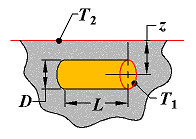
The heat transfer from one surface (at a temperature T1) to the other surface (at T2) can be expressed as: q=Sk(T1-T2) where k is the thermal conductivity of the solid and S is the conduction shape factor.
Example: Shape factors may also be defined for one-dimensional geometries as given by cases 12 through 14.
es: Factor de forma de conducción
Convection resistance
Noun
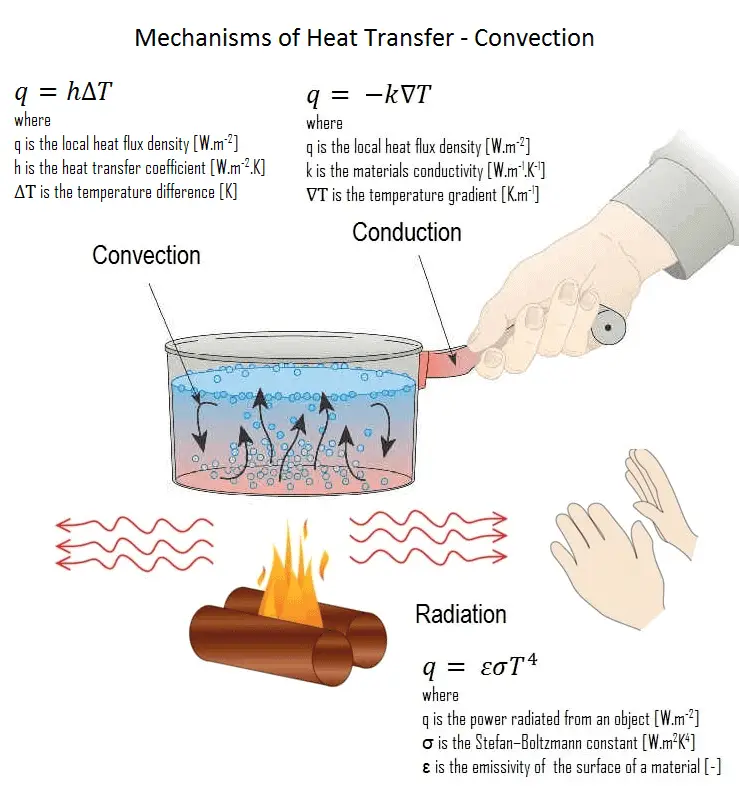
Convective Thermal Resistor. Convective Thermal Resistor. where Rconv (SI unit: K/W) is the thermal resistance, which is defined from the surface Area A and the Heat transfer coefficient h as. Model Input. This section has fields and values that are inputs to expressions that define material properties.
Example: Here, is the change of temperature and h is the convection resistance. ... Which means, the convection resistance per unit area is the inverse of the convection heat transfer coefficient.
es: Resistencia a la convección
Critical radius of insulation
Noun
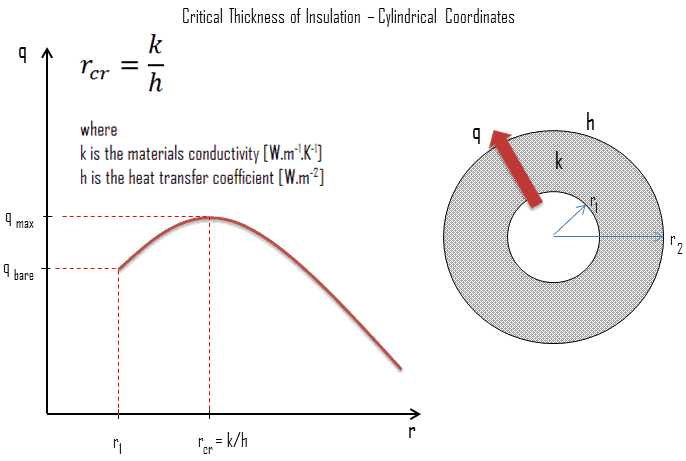
The critical radius of insulation is a counterintuitive concept within the study of heat transfer. The theory states that adding insulation to a cylindrical or spherical object will increase the rate of heat loss rather than decrease it, if the radius (thickness) of the insulation is at its “critical” value.
In a cylindrical pipe or a spherical shell, the additional insulation increases the conduction resistance of insulation, but decreases the convection resistance of the surface because of the increase in the outer surface area. Due to these opposite effects, a critical radius of insulation is defined as the outer radius that provides maximum rate of heat transfer. For a cylindrical layer, it is defined as rcr k / h where k is the thermal conductivity of insulation and h is the external convection heat transfer coefficient.
Example: Yes, the measurements can be right. If the radius of insulation is less than critical radius of insulation of the pipe, the rate of heat loss will increase.
es: Radio crítico de aislamiento
Cylinder conduction resistance
Noun
Chemical engineers encounter conduction in the cylindrical geometry when they analyze heat loss through pipe walls, heat transfer in double-pipe or shell-and-tube heat exchangers, heat transfer from nuclear fuel rods, and other similar situations. Unlike conduction in the rectangular geometry that we have considered so far, the key difference is that the area for heat flow changes from one radial location to another in the cylindrical geometry. This affects the temperature profile in steady conduction. As an example, recall that the steady temperature profile for onedimensional conduction in a rectangular slab is a straight line, provided the thermal conductivity is a constant. In the cylindrical geometry, we find the steady temperature profile to be logarithmic in the radial coordinate in an analogous situation. To see why, let us construct a model of steady conduction in the radial direction through a cylindrical pipe wall when the inner and outer surfaces are maintained at two different temperatures.
Example: Chemical engineers encounter conduction in the cylindrical geometry when they analyze heat loss through pipe walls, heat transfer in double-pipe or shell-and-tube heat exchangers.
es: Resistencia de conducción del cilindro
Efficiency
Noun
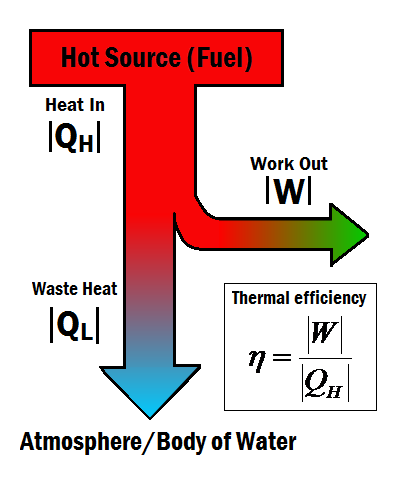
In thermodynamics, efficiency is one of the most frequently used terms to indicate how well energy is converted into useful work. Generally it is defined as the ratio of desired output to required input. Energy efficiency (i.e. ratio of output energy to input energy) is primarily based on the 1st law of thermodynamics. It helps to understand the system’s behaviour to some extent and provides the relative magnitude of energy losses, but does not include the usability of the converted energy. In other words it only considers the quantity of energy but not the quality level of the converted energy in its analysis.
Example: In contrast to energy efficiency, exergy efficiency (i.e. ratio of output exergy to input exergy) is based on combing the 1st and 2nd laws of thermodynamics. It includes the quality level of the converted energy, and thereby determines the true magnitudes of energy losses, their causes and locations.
es: Eficiencia
Fin effectiveness
Noun
The fin temperature effectiveness or fin efficiency is defined as the ratio of the actual heat transfer rate through the fin base divided by the maximum possible heat transfer rate through the fin base, which can be obtained if the entire fin is at base temperature (i.e., its material thermal conductivity is infinite).
Example: Fin Efficiency and Surface Effectiveness. Fin efficiency is defined as the ratio of actual heat flow of the fin to that which would be obtained with a fin of constant temperature uniformly equal to the base surface temperature, that is, one with infinite thermal conductivity.
es: Eficacia de la aleta
Fin efficiency
Noun
Fin efficiency is defined as the ratio of actual heat flow of the fin to that which would be obtained with a fin of constant temperature uniformly equal to the base surface temperature, that is, one with infinite thermal conductivity.
Example: The fin efficiency, η, is defined as the ratio of the apparent rate of heat dissipation of a fin to the ideal rate of heat dissipation if the entire fin surface were at Tw, i.e.
es: Eficiencia de las aletas
Interface resistance
Noun
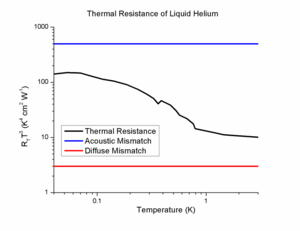
Interfacial thermal resistance, also known as thermal boundary resistance, or Kapitza resistance, is a measure of an interface's resistance to thermal flow. This thermal resistance differs from contact resistance (not to be confused with electrical contact resistance) because it exists even at atomically perfect interfaces. Owing to differences in electronic and vibrational properties in different materials, when an energy carrier (phonon or electron, depending on the material) attempts to traverse the interface, it will scatter at the interface. The probability of transmission after scattering will depend on the available energy states on side 1 and side 2 of the interface.
Example: Assuming a constant thermal flux is applied across an interface, this interfacial thermal resistance will lead to a finite temperature discontinuity at the interface. From an extension of Fourier's law.
es: Resistencia de interfaz
Plane wall conduction resistance
Noun
HEAT CONDUCTION THROUGH A PLANE WALL • Let us consider a plane wall of homogeneous material through which heat is flowing in x-direction. • Let Q +x L = thickness of the wall T0 A = cross-sectional area of the wall k k = thermal conductivity of wall material T1 T0 , T1 = temperature maintained at surfaces 1 and 2.
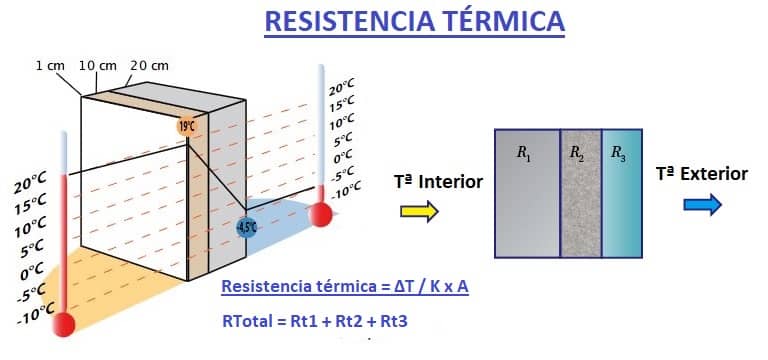
Rwall is the thermal resistance of the wall against heat conduction or simply the conduction resistance of the wall. Rconv is the thermal resistance of the surface against heat convection or simply the convection resistance of the surface.
Example: HEAT CONDUCTION THROUGH A PLANE WALL • Let us consider a plane wall of homogeneous material
es: Resistencia a la conducción de la pared plana
Radiation resistance
Noun
The radiation resistance is determined by the geometry of the antenna and the operating frequency. The total feedpoint resistance at the antenna's terminals is equal to the radiation resistance plus the loss resistance due to ohmic losses in the antenna. In a receiving antenna the radiation resistance represents the source resistance of the antenna, and the portion of the received radio power consumed by the radiation resistance represents radio waves reradiated (scattered) by the antenna.
Example: Radiation resistance is that part of an antenna's feedpoint electrical resistance that is caused by the radiation of electromagnetic waves from the antenna.
es: Resistencia a la radiación
Sphere conduction resistance
Noun
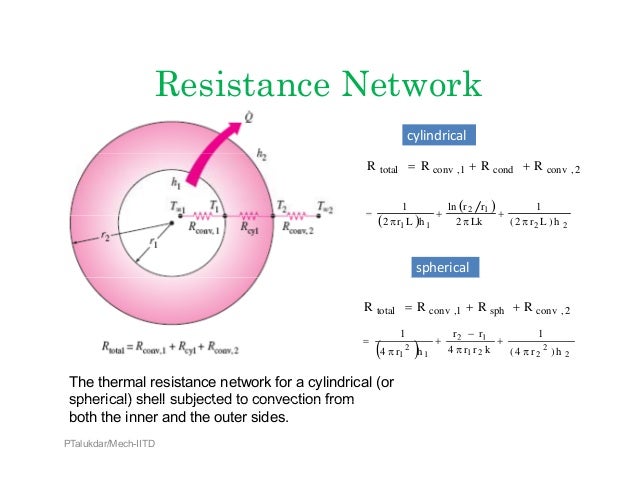
Consider heat conduction through a hollow sphere of inner radius r1, outer radius r2 and made of a material of constant thermal conductivity. The inner and outer surfaces are maintained at constant but different temperatures t1 and t2 respectively. Geometrical symmetry indicates that the heat flow is limited to radial direction only. Further if temperature t1 at the inner surface is greater than temperature t2 at the outer surface, the heat flows radially outwards.
Example: Can the thermal resistance concept be used for a solid cylinder or sphere in steady operation? O Yes O No Consider a short cylinder whose top and bottom surfaces are insulated.
es: Resistencia a la conducción de la esfera
Surfaces
Noun/Verb
In physics , a surface is a two-dimensional geometric extent, on which it is locally possible to locate using two real coordinates , as in the plane (with the abscissa and the ordinate ) or on a sphere ( with latitude and longitude ). A surface generally appears as an interface between two media, or between the interior and exterior of a physical system, supporting a surface distribution of a scalar field , or through which a flow passes.of a vector field . The physical phenomenon analyzed then relates locally to a surface element with a vector character. The surface is also a physical quantity , which globally measures the geometric extent of this interface, most often in the form of a double integral. This physical quantity then has an extensive scalar character.
Example: The analysis of a physical system characterized by a surface frequently led to study the surface distribution of a certain physical quantity X . In the case, the surface considered is normally a material surface, limit of a physical body or interface between two media.
es: Superficie
Thermal contact conductance
Noun
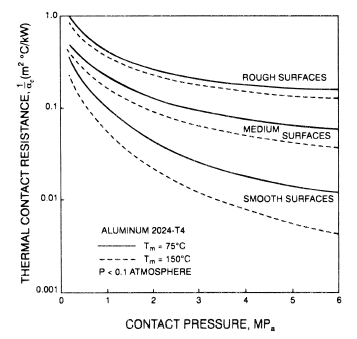
In physics, thermal contact conductance is the study of heat conduction between solid bodies in thermal contact. The thermal contact conductance coefficient, {\displaystyle h_{c}}h_{c}, is a property indicating the thermal conductivity, or ability to conduct heat, between two bodies in contact. The inverse of this property is termed thermal contact resistance.
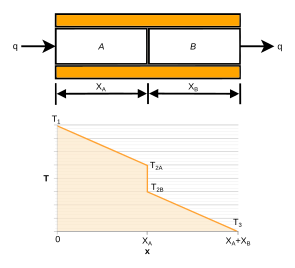
When two solid bodies come in contact, such as A and B in Figure 1, heat flows from the hotter body to the colder body. From experience, the temperature profile along the two bodies varies, approximately, as shown in the figure. A temperature drop is observed at the interface between the two surfaces in contact. This phenomenon is said to be a result of a thermal contact resistance existing between the contacting surfaces. Thermal contact resistance is defined as the ratio between this temperature drop and the average heat flow across the interface.
Example: Most experimentally determined values of the thermal contact resistance fall between 0.000005 and 0.0005 m2 K/W (the corresponding range of thermal contact conductance is 200,000 to 2000 W/m2 K).
es: Conductancia de contacto térmico
Thermal contact resistance
Noun
Thermal contact resistance is defined as the ratio between this temperature drop and the average heat flow across the interface. According to Fourier's law, the heat flow between the bodies is found by the relation: where is the heat flow, is the thermal conductivity, is the cross sectional area and.
Example: Some additional factors which may affect the contact resistance are the direction of the heat flux, surface scratches or cracks, nonuniform loading which causes uneven contact pressure, relative motion or slipping between the surfaces, and the presence of oxides or contaminants on the contacting surfaces.
es: Resistencia al contacto térmico
Total thermal resistance
Noun
Thermal resistance is a heat property and a measurement of a temperature difference by which an object or material resists a heat flow. Thermal resistance is the reciprocal of thermal conductance.
*(Absolute) thermal resistance R in kelvins per watt (K/W) is a property of a particular component. For example, a characteristic of a heat sink.
*Specific thermal resistance or thermal resistivity Rλ in kelvin metres per watt (K⋅m/W), is a material constant.
*Thermal insulance has the units square metre kelvin per watt (m2⋅K/W) in SI units or square foot degree Fahrenheit hours per British thermal unit (ft2⋅°F⋅h/Btu) in imperial units. It is the thermal resistance of unit area of a material. In terms of insulation, it is measured by the R-value.
Absolute thermal resistance is the temperature difference across a structure when a unit of heat energy flows through it in unit time. It is the reciprocal of thermal conductance. The SI unit of absolute thermal resistance is kelvins per watt (K/W) or the equivalent degrees Celsius per watt (°C/W) – the two are the same since the intervals are equal: ΔT = 1 K = 1 °C.
The thermal resistance of materials is of great interest to electronic engineers because most electrical components generate heat and need to be cooled. Electronic components malfunction or fail if they overheat, and some parts routinely need measures taken in the design stage to prevent this.
Example: Total thermal resistance is the reciprocal of thermal conductance. Just as an electrical resistance is associated with the conduction of electricity, a thermal resistance may be associated with the conduction of heat.